skip to main |
skip to sidebar
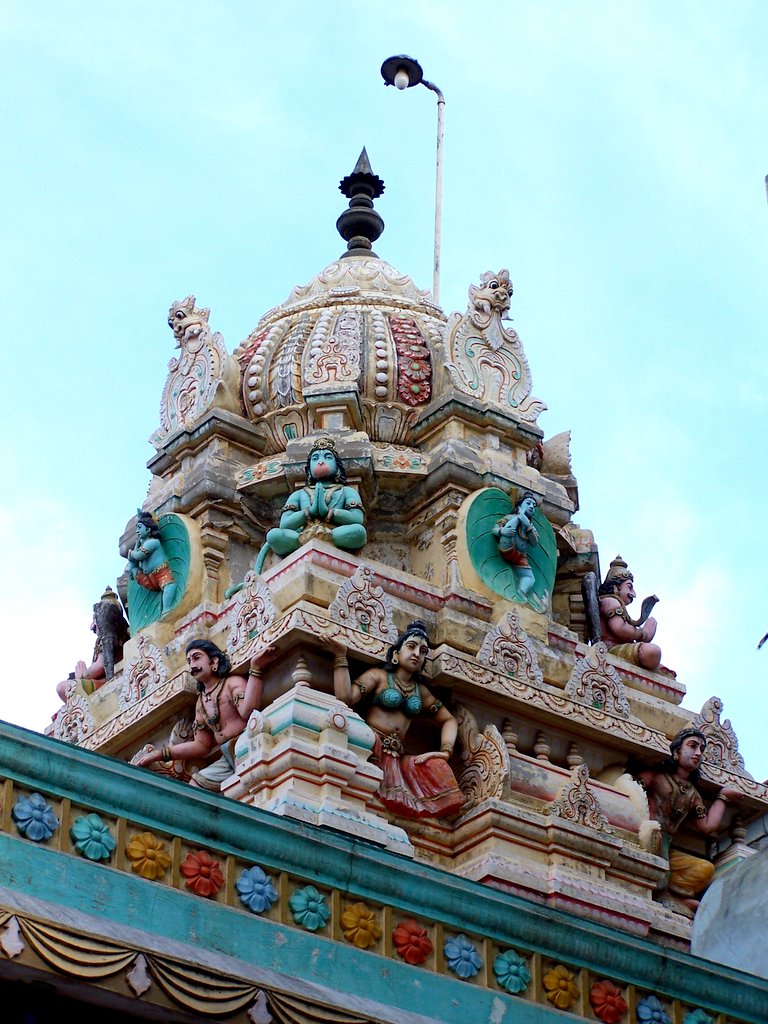
 Temple architecture in the Hindu tradition is connected to astronomy and sacred geometry. The temple is a representation of the macrocosm (the universe) as well as the microcosm (the inner space).
A basic Hindu temple consists of an inner sanctum, the garbha griha or womb-chamber, in which the image is housed, often with space for its circumambulation, a congregation hall, and possibly an antechamber and porch. The sanctum is crowned by a tower-like shikara,as shown here.
The earliest temples were built with perishable materials like timber and clay. Cave-temples, temples carved out of the stone or built with bricks came later. Heavy stone structures with ornate architecture and sculpture belong to a still later period. In spite of the basic pattern being the same, varieties did appear, gradually leading to the evolution of different styles in temple architecture. More >>
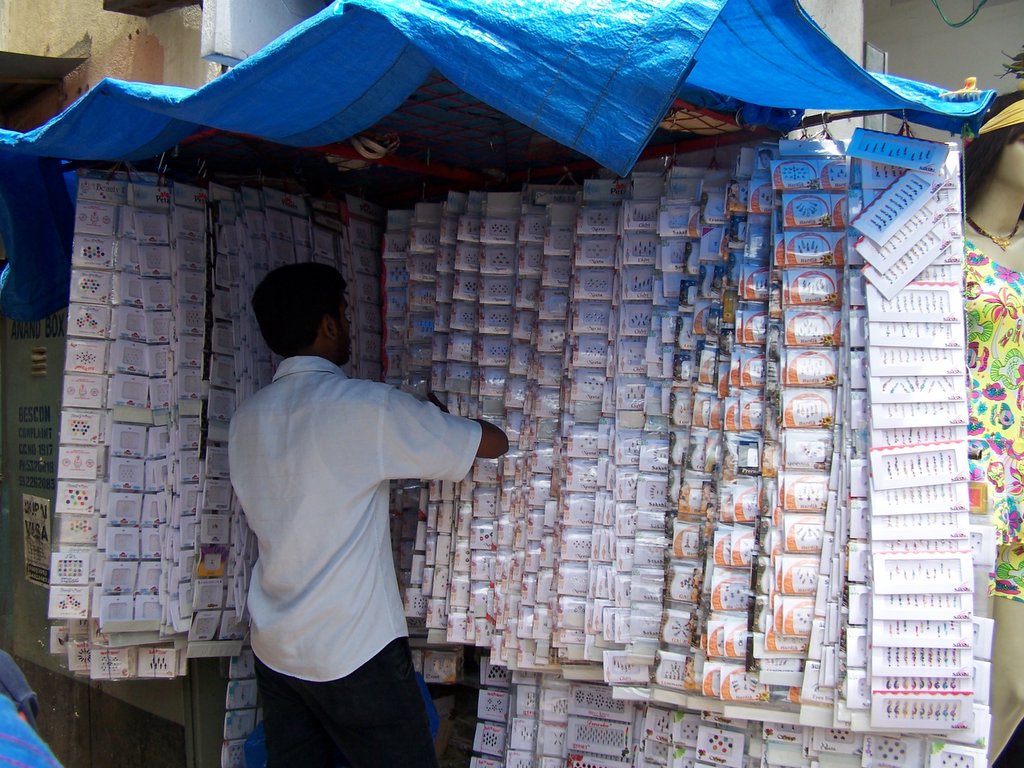
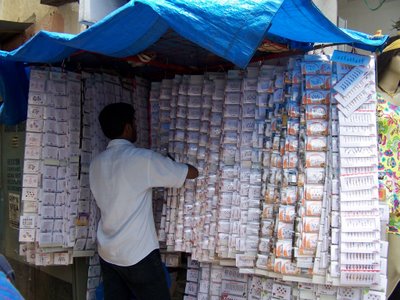 Roadside Modern "Bindi" Stall on commercial Street.... Married Hindu women traditionally wear a bindi on their foreheads. The traditional bindi is made with red sindoor powder or perhaps a black ointment. It is applied over the ajna, or forehead chakra, a center of bodily and spiritual energy that represents the third, or "spiritual" eye in Hindu belief.
The bindi is believed to prevent the loss of "energy", as well as bringing spiritual protection against demons or bad luck. See tilaka for further discussion of the spiritual meaning of the bindi. More>>
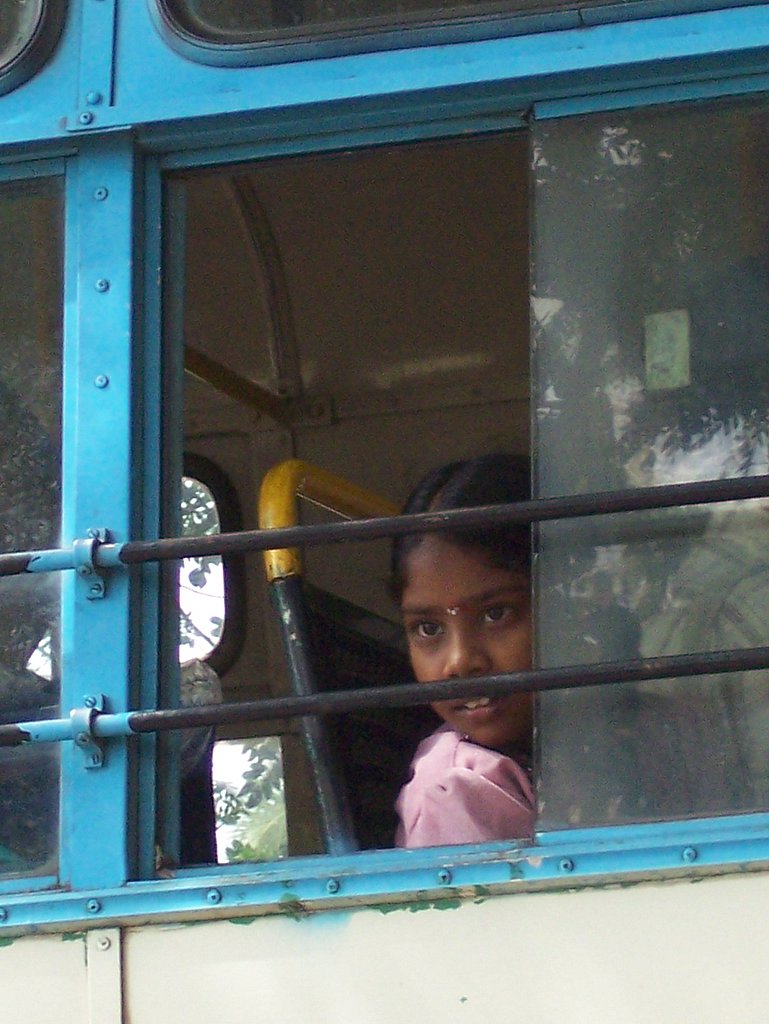
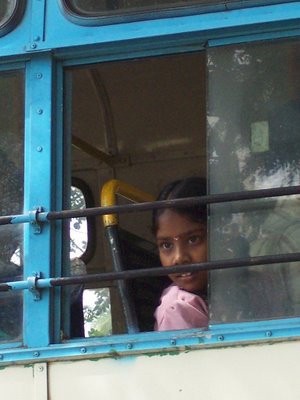 Overlooking through the window of BMTC bus, girl seems amazed to look the city galore. The Government introduced "Grameena Saarige" ( Rural transport) for the rural areas close to the city, these buses help them commute in and out of city with an ease which without them was challenging.
Today, they are the only profit making urban sector public corporation in India. BMTC has become the first public sector city transport carrier to introduce Air Conditioned Volvo Buses. BMTC plans to introduce more such buses to ease passenger discomfort. It has also introduced slew of measures to improve efficiency and women emancipation by making it mandatory that 33% of BMTC staff need to be women. Probably only city in India having lady conductors.
Around 41 per cent of Bangalore's population depends on the Bangalore Metropolitan Transport Corporation (BMTC) buses. While the future holds the promise of a Metro Rail system, some experts say that the planned Metro network does not seem to fit in well into the overall transport plan. It is a different story that the city lacks an integrated transportation plan. more>>
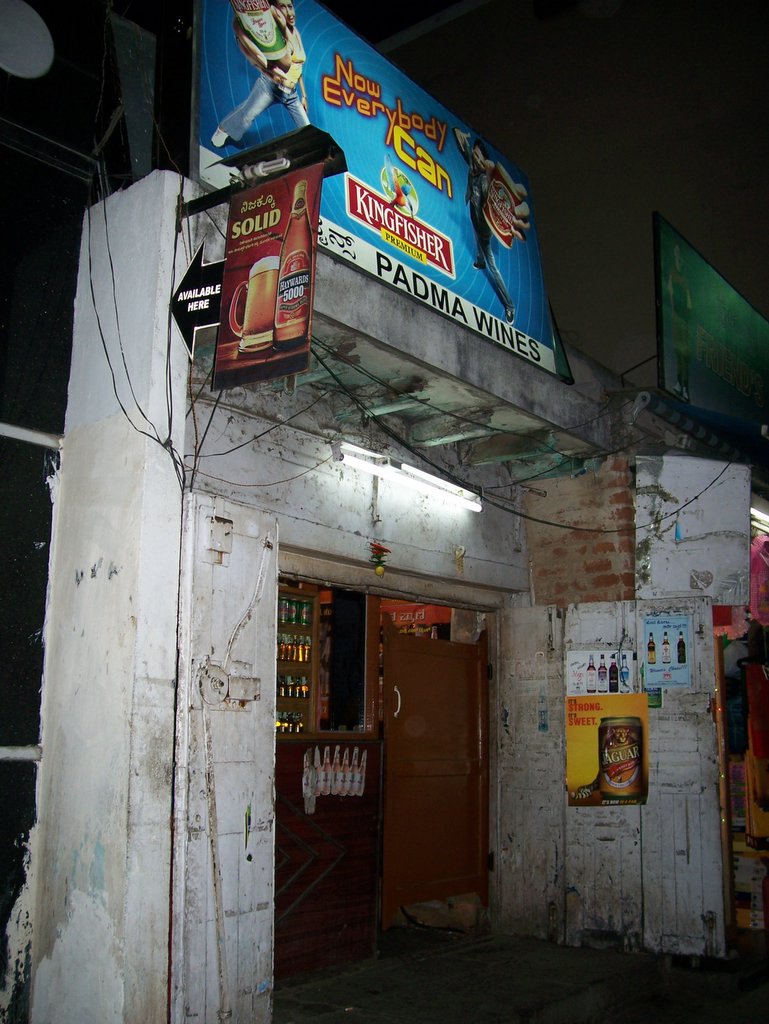
Drinking is an age-old habit, evident from the numerous allusions to ‘tipsy’ gods and demons in epics and myths. Alcohol pervades, satisfies and plagues the world. It has been looked upon as a necessary social evil from times immemorial.
Bangalore has an active night culture and is home to over 200 clubs and bars. The city is also referred to by many as the "Pub Capital of India". Besides the swank pubs which are the toast of the city, smaller bars have sprung up along the high ways causing accidents to rise on these already dangerous roads.
"Drinker's city" Bangalore is evolving a new trend in the economics of alcohol, apparently an increasing number of habitual middle class drinkers deposit a certain sum estimated to cover their drinking for the month in advance to the wine shops. This is intended to avoid the periodic arguments with their wives over the money demanded for drinking! Budget for wasteful expenses in order to avoid arguments - how ingenious!
The famous "pub culture" of Bangalore seems to have a lot of scary fallouts.A study taken up by the Psychiatry De-addiction Unit of Nimhans in 2003 revealed that an increasing number of young women in Bangalore may be heading towards the peril of alcoholism, starting as young as 15 or 16.
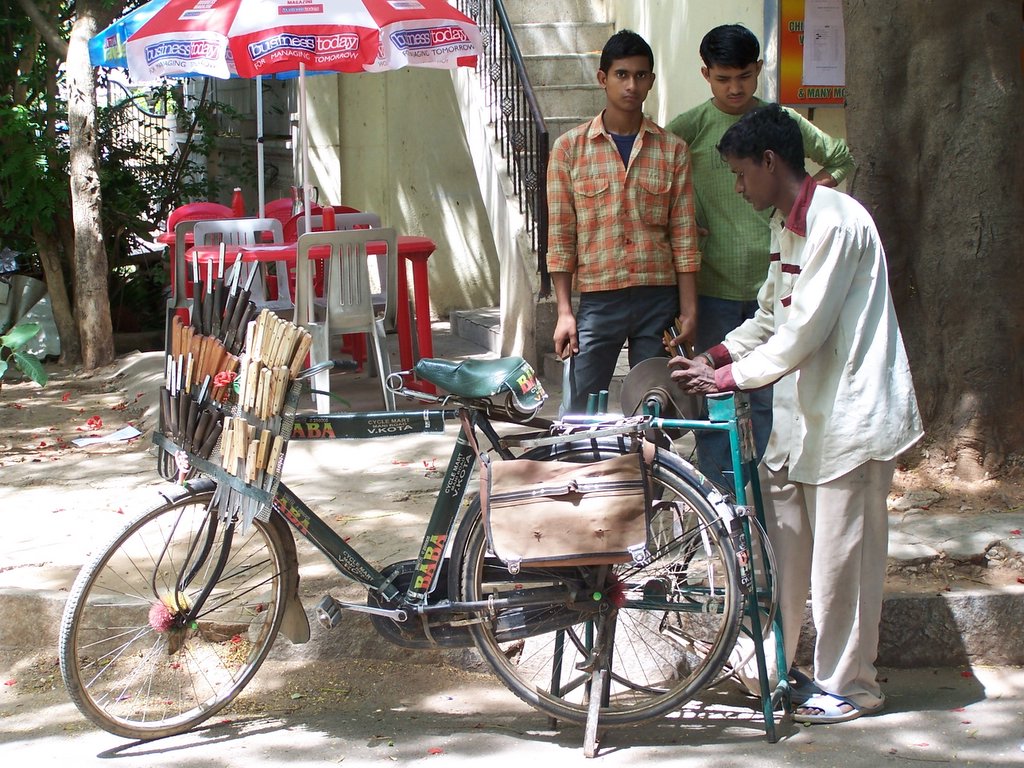
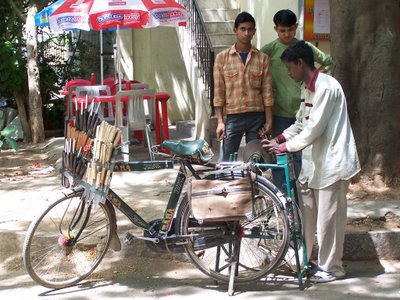 Knife sharpner at work, get the edge sharpened or get one new... Knives are sharpened by grinding against a hard rough surface, typically stone, or a soft surface with hard particles, such as sandpaper or a razor strap. The smaller the angle between the blade and stone, the sharper the knife will be, but the less side force is needed to bend the edge over or chip it off.
In general, the harder the material to be cut the higher the angle of the edge. The composition of the stone affects the sharpness of the blade (finer grain produces sharper blades), as does the composition of the blade (some metals take/keep an edge better than others).
Honing stones (also called whetstones) come with coarse and fine grits and can be hard or soft describing whether the grit comes free. Arkansas is a traditional source for honing stones, which are traditionally used with water or honing oil. India is another traditional source for stones. Ceramic hones are also common, especially for fine grit size. Water stones (both artificial and natural) come in very fine grits. They are stored in water, and develop a layer of slurry which dulls the edge if the blade is honed as if honing into the stone. Generally, these are more costly than oilstones. Coated hones, which have an abrasive, sometimes diamonds, on a base of plastic or metal are another kind of hone. Sharpening blocks made with corundum are available, but expensive. More >>

The Bangalore Cantonment Station is the most central station in Bangalore and is the entry point for trains to go from Bangalore to other cities in India. Cantonment was a military cantonment of the British Raj based in Bangalore. The cantonment covered an area of 13 miles2, extending from the Residency on the west to Binnamangala on the east and from the Tanneries in the north to Agram in the south. By area, it was the largest British military cantonment in South India.
The British garrison stationed in the cantonment included three artillery batteries, and regiments of the cavalry, infantry, sappers, miners, mounted infantry, supply and transport corps and the Bangalore Rifle Volunteers. The Bangalore Cantonment was directly under the administration of the British Raj, while Bangalore City itself was under the jurisdiction of the Durbar of the Kingdom of Mysore.
The names of many of the cantonment's streets were derived from military nomenclature such as Artillery Road, Brigade Road, Infantry Road and Cavalry Road. The city of Bangalore still retains many of the colonial names of its streets. More >>
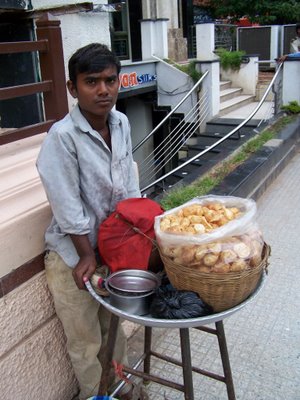 Panipuri, or Pani puri, is a snack synonymous with the beaches of Mumbai, now has even started being visible on Bangalore streets like this on on MG Road. However, it is also very popular in all other parts on India known by many names like golgappa (plural golguppe) in North India, Foochka (Puchka) in West Bengal, Gupchup in some central parts of India like Hyderabad. More >>
It is made from small, round, puffed, hard puris which form the 'container' or shell, and mashed potatoes and cooked chick-peas along with some finely cut onions, with salt and pepper added, and the chutneys are the stuffing. Normally, there are two chutneys, the hot and the sweet, each in a large round mud (or, nowadays, metal) vessel; although sometimes there is only one. This snack is not just delicious, it is also fun to make and eat. Here is the recipe...

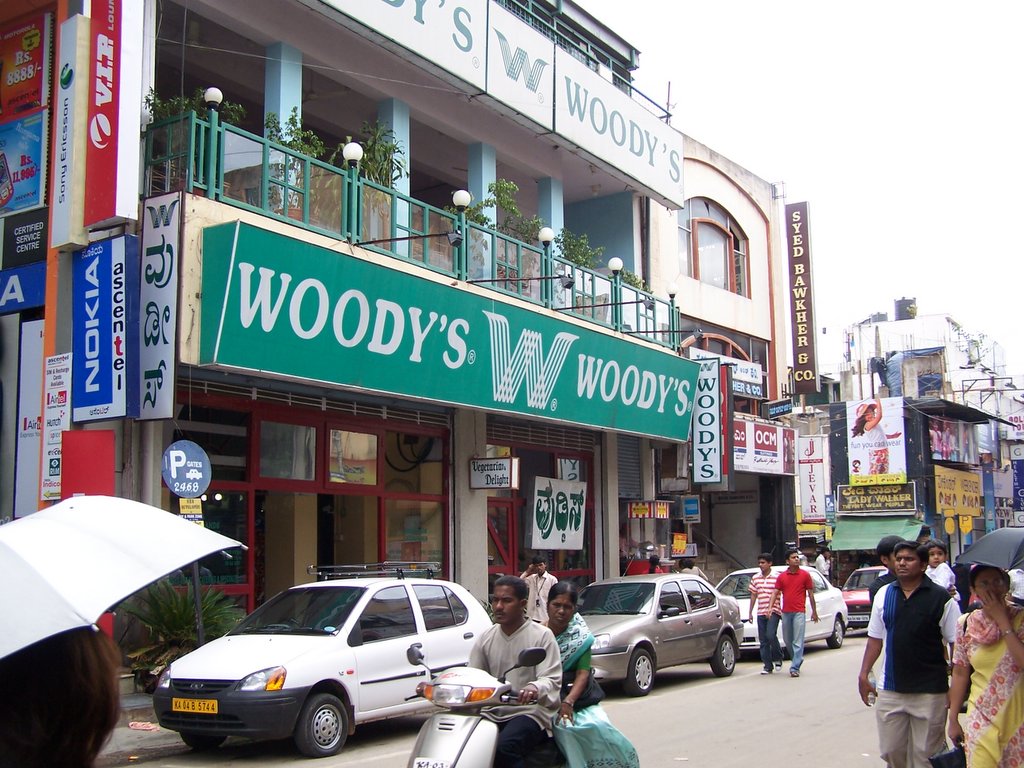
Woodys at Commercial Street is a welcome eaterie in the whole Street. It makes a lot of business sense for the restaurant from the locational point of view as there are no other good hotels nearby (Disclaimer – Atleast nothing visibly and till the time we visited the place). Part of the Woodlands group of hotels, Woodys is their chain of restaurants with the other restaurant outlets of the group situated at Jayanagar in Bangalore and Kodaikanal in Tamilnadu. The hotel has a big “W” as its logo and uses green colour as its theme.
The Woodys outlet have separate provision of ‘self-service’ and ‘service’ areas. If you are in a hurry, then ‘self-service’ area is what you should be looking for. The service area is well ‘manned’ and the service is also quite prompt. The menu is exhaustive and has almost all the varieties of both North Indian and South Indian food.
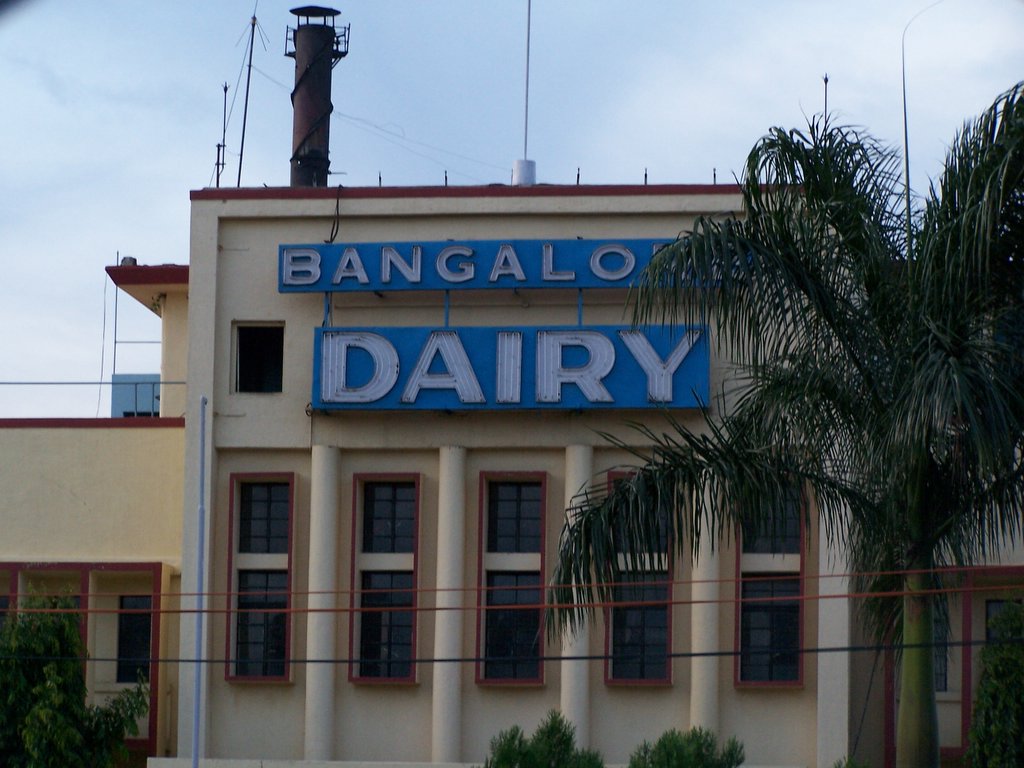
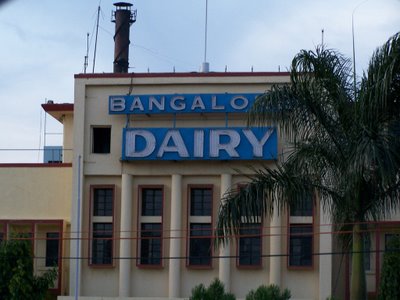 Bangalore Dairy, which began processing milk in 1965 with an initial capacity of 50,000 Litres Per Day(LPD), was inaugurated on 23.1.1965 by late Sri.Lal Bahadur Shastriji, the then Hon'ble Prime Minister of India. Later the capacity was enhanced to 3.50 Lakh Litres Per Day.This Union is one of the first four Milk Unions to be covered under the First World Bank Project.
Karnataka Cooperative Milk Producers' Federation Limited (KMF) is the Apex Body in Karnataka representing Dairy Farmers' Co-operatives. It is the third largest dairy co-operative amongst the dairy cooperatives in the country. In South India it stands first in terms of procurement as well as sales. One of the core functions of the Federation is marketing of Milk and Milk Products. The Brand 'Nandini ' is the household name for Pure and Fresh milk and milk products. More >>
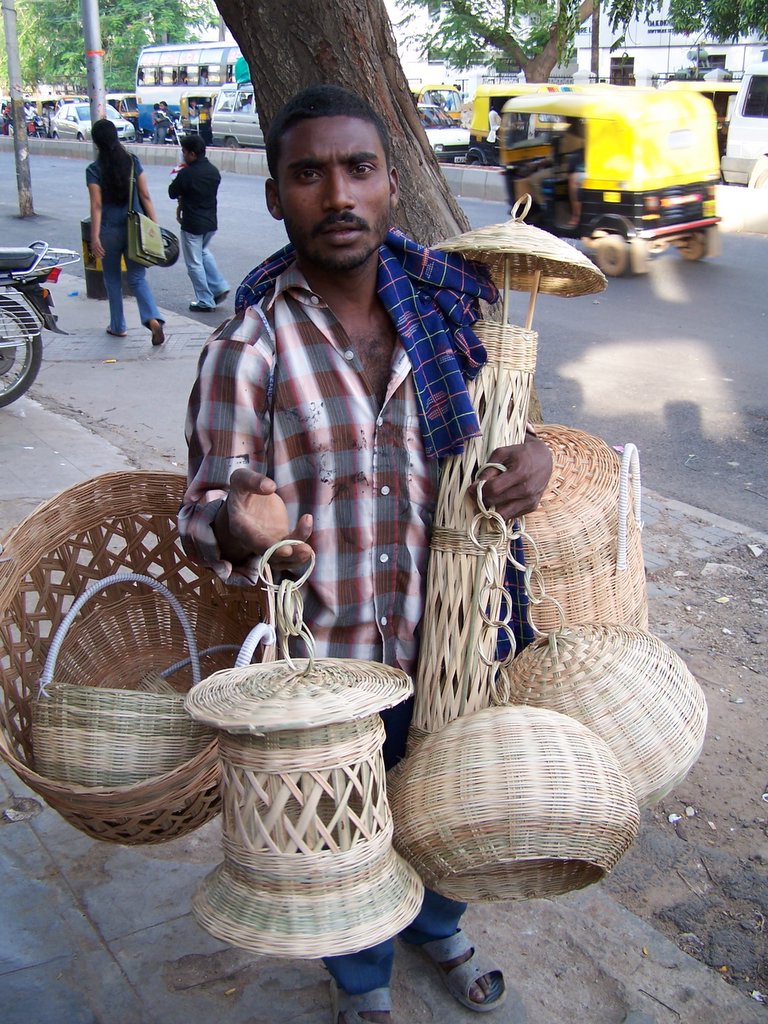
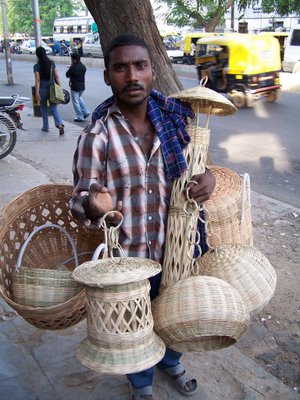 Earning money in the metro has unlimited options ...a bamboo art worker roams around busy koramangala street to make quick bucks by selling the Cane lamps, baskets ... the dry climate of bangalore compliments use of cane furniture and is a perfect reflection of natural representation in one's household...
The forests of Karnataka provide the bamboo that is used in the making of beautiful handicraft. The bamboo has to be cut into strips of equal breadth and thickness, a skill that takes years to master. India being the second richest country in bamboo genetic resources after China. These two countries together have more than half the total bamboo resources globally. It is reported that 136 species of bamboos occurring in India. More >>
 Bangles are ornaments worn mainly by women on their arms and wrists. They are usually circular in shape, and, unlike bracelets, are not flixible.
Bangles are part of traditional Indian jewelry. In India, bangles are usually worn in pairs, one or more on each arm, and a single bangle is rarely sold. They are made of numerous precious as well as non-precious materials such as gold, silver, platinum, glass, wood, ferrous metals, plastic, etc.
Most Indian women prefer wearing either gold or glass bangles or both in combination. Bangles made from plastic are slowly replacing those made by glass, but the ones made of glass are still preferred at traditional functions such as marriages and at festivals.
Gold bangles are most popular with indian women. They range from plain and simple to extremely artistic and intricate. They are often studded with precious and semi-precious stones such as diamonds, gems and pearls. More >>
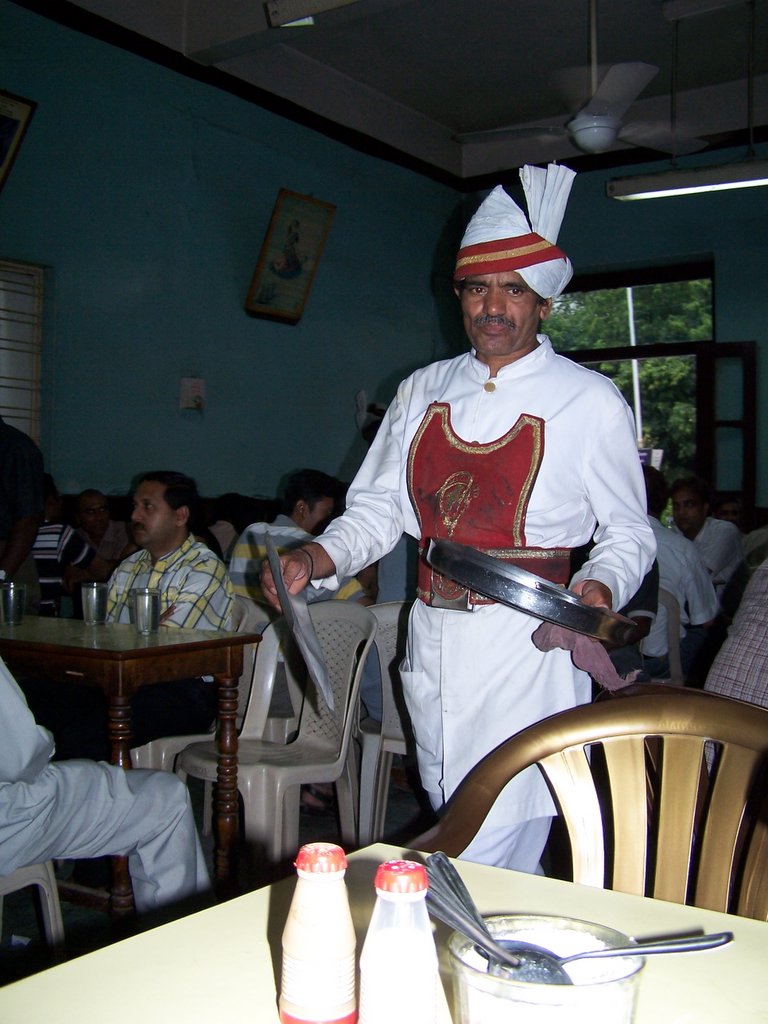
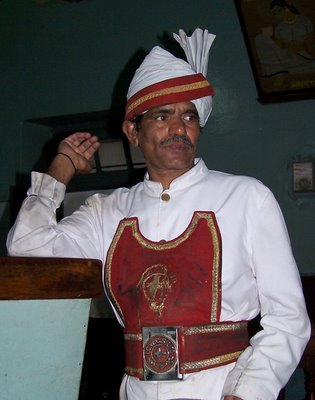
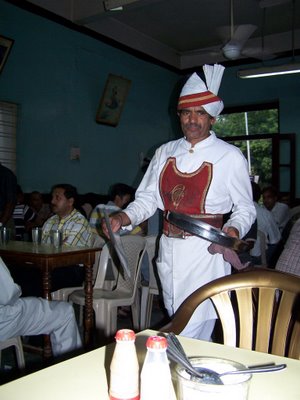 India Coffee House on MG Road (Scrambled Egg Toast, Masala Dosa), As tyhe name suggests the place is known for it's Coffee...served by the turbanrd waiters.
The waiters took their own time to serve you, so you sat there reading your morning newspapers, in no hurry to go anywhere. Nobody asked you to leave and you could sit there until you found something else to do. Sometimes it seemed as though there were four waiters to a customer, hanging around chatting in corners, until somebody waved out to them to catch their attention.
Indian coffee is the most extraordinary of beverages, offering intriguing subtlety and stimulating intensity. India is the only country that grows all of its coffee under shade. Typically mild and not too acidic, these coffees possess an exotic full-bodied taste and a fine aroma. More >>