Showing posts sorted by relevance for query knife. Sort by date Show all posts
Friday, May 19, 2006
Friday, August 04, 2006
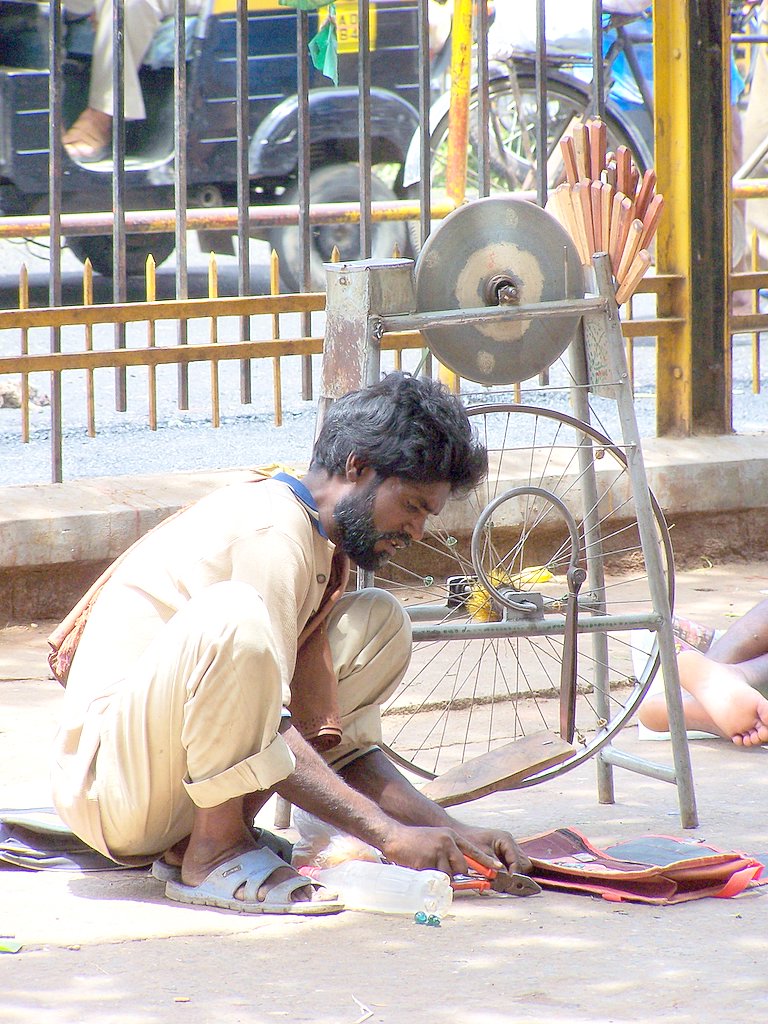
Sharpening the Edges...

Knife sharpner at work, get the edge sharpened or get one new... Knives are sharpened by grinding against a hard rough surface, typically stone, or a soft surface with hard particles, such as sandpaper or a razor strap. The smaller the angle between the blade and stone, the sharper the knife will be, but the less side force is needed to bend the edge over or chip it off.
In general, the harder the material to be cut the higher the angle of the edge. The composition of the stone affects the sharpness of the blade (finer grain produces sharper blades), as does the composition of the blade (some metals take/keep an edge better than others).
Honing stones (also called whetstones) come with coarse and fine grits and can be hard or soft describing whether the grit comes free. Arkansas is a traditional source for honing stones, which are traditionally used with water or honing oil. India is another traditional source for stones. Ceramic hones are also common, especially for fine grit size. Water stones (both artificial and natural) come in very fine grits. They are stored in water, and develop a layer of slurry which dulls the edge if the blade is honed as if honing into the stone. Generally, these are more costly than oilstones. Coated hones, which have an abrasive, sometimes diamonds, on a base of plastic or metal are another kind of hone. Sharpening blocks made with corundum are available, but expensive. More >>
Posted by Unknown 6 comments
Labels: Bangalore
Subscribe to:
Posts (Atom)